Patterns As Prisons

Dewitt Jones  “Our patterns, too long unquestioned, become our prisons. Break the pattern! And see the scene before you with new eyes.”

Weekly I receive a picture and quote from DeWitt Jones, an internationally known photo journalist who is committed to viewing life and the world as something to celebrate every single day.  This weeks picture and quote made me start thinking about the patterns of breathing that we inhabit on a moment to moment basis, most of which we are completely unaware of.

What I saw in the pattern of the regimented vineyard above was multifaceted.  The red bucket of course interrupts the necessary uniformity required to grow and harvest grapes – almost as if it was an exclamation point thrown in to startle the eyes from only seeing a certain pattern.  The mass of yellow flowers beneath support the possibility of other choices as they wildly grow in whatever way they choose.

Having lived in wine country for 14 years I was used to seeing scenes such as the one in this picture and noticed when the new growth or Fall colors would change the landscape and thus the pattern.  However, there was always an underlying blueprint that best supported optimal growth.

This is how I see the patterns of our breathing.  The underlying blueprint for optimal breathing was installed before you were even born and activated once you took your first breath.  It is what is overlaying this healthy natural breath blueprint that I address here.

A very large percentage of people breathe very shallowly using secondary breath muscles (neck, upper back and chest).  Consequently why there is so much tension and discomfort in the head, neck and shoulders.  These muscles were never meant to be the primary care giver for the breath. They are often depended on because of bad posture, sitting for long periods of time, stress and fear, and most certainly lack of daily movement to stimulate natural breathing cycles as a result of being in our heads way too much of the time.

Did you know that there is a correlation between upper chest breathing and heart disease?  Of note is that almost all people that have had heart attacks are presumably chest breathers.  The heart is attached to the diaphragm by fascia.  Each time we breathe utilizing the diaphragm and other primary muscles for breathing the heart is massaged!

This is just one of the many benefits that a natural fluid diaphragmatic breath can bring.  Our primary breathing muscles are the thoracic diaphragm, the muscles between the ribs (intercostals), and the abdominal muscles (front of belly) as well as the pelvic diaphragm.  When you breathe in a natural healthy way the breath should be felt in pelvis, belly, back, and all of the ribcage.

Invite a full embodied breath in today and give it to the rising sun – a key to break free of the patterns that have captured your vital health and aliveness!

OTHER BLOGS BY GAYE ABBOTT:

www.NaturalWealthJournal.com
www.WildlyFreeWoman.com

WEBSITE:  www.IgniteWealthNow.com
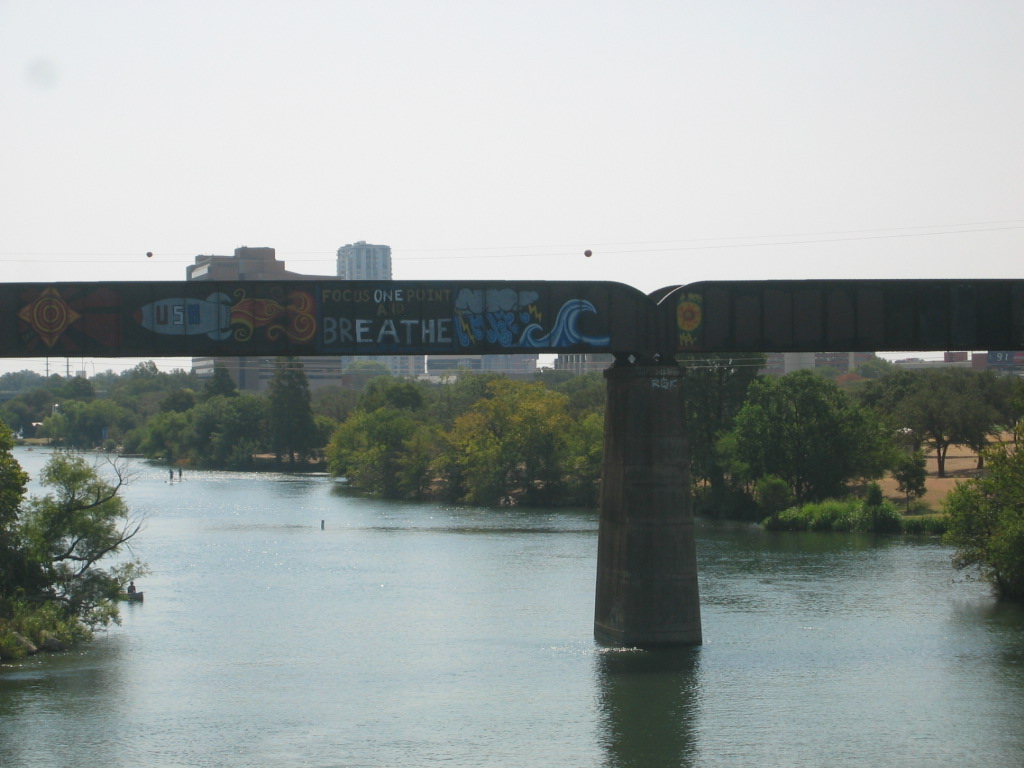
STOP! Unplug…..Focus One Point and Breathe

Yes.  I am going to invite you to go on a “media fast” this week.  That means smart phones, internet, television, newspapers, ……   Choose one day, or take the entire week.  It is up to you.

The reason for this is to open into possibilities that are obscured by the sheer volume of stimulus that captures our attention every single moment of every single day.

What would it be like to have space to notice what is going on in the world around you….not what you are being told is going on.

Take as an example my experience in doing this for the past 3 days in which I let go of my resistance to writing the first draft of a book on the breath that I have been sitting on for the past year.  I knew clearly that there were ideas and  creative paths that would not be open to me if I was returning e-mails, talking to people on the phone, and going out to make social connections.  Television and newspapers have not been part of my daily life for many years now, so that part was easy.

So I stopped.  I created a space for writing and just being with what unfolded itself before and within me.  So much more space appeared….and time slowed down.  The creative muse inside woke up and started an ongoing celebration resulting in an out pouring of ideas that resulted in 12,000 words written in 3 days.

During this three days I took a walk around the local lake here in Austin, Texas in the sultry 90 degree heat.  Not plugged into anything while I walked I was free to observe nature, people, dogs and the morning.

Half way through my walk I took a seat on a bench placed high above the lake on a pedestrian bridge.  My back was to another rail bridge that I had noticed before.  On it is painted in colors:  Focus One Point…and Breathe.  Graffiti art of the sacred kind.

With that reminder I did just that, and instead of being distracted by my minds constant barrage of chatter I was quieted as I gazed at the Lamar Street bridge directly in front of me, constructed with gracefully curved cement supports.  Sunlight helped to mirror these supports in the water creating an art piece of beautiful duplication.  What was above the water was also below.

It appeared to be another world in the water that was reverse from the one in air.  As I continued gazing a cloud obscured the reflection for a few moments and the magical world beneath the water was in shadow, disappearing before my eyes.  Once the light came out from behind the cloud this under water world was revealed once again.  It was there all along.

How many worlds, or possibilities are in the shadows, but still really there for us to shed light on and actively explore? Sitting with this I gazed down at the sidewalk just to my left and on it was written in colored chalk, “God bless you  friend” with a heart drawn at the end.

Walking back along the path I greeted an Austin resident who had brought his wheelbarrow down to the lake in order to transport water to the drought affected trees that grace this path.  Thanking him for what he was doing out of the kindness of his heart we exchanged a smile.  I am certain the trees felt the love directed at them.

Finally, climbing into my car and reaching to peel the juicy orange that awaited my return a man approached with a one gallon gas container.  He asked if I could spare some money to complete what he had in his pocket to purchase one gallon of gas.

Reaching into my wallet I took out my last dollar bill and grabbed some quarters and handed them to him commenting to please excuse the quarters as they had a bit of dark chocolate melted onto them.  We exchanged a smile and I was told once again “Thank you and God bless!”’’

Now, my question is would I have experienced all of this if I had earplugs in listening to music or whatever, allowed my mind to set an agenda of a certain time I needed to be back home to begin writing again, had my eyes down on the path focused on how many miles I needed to go today in order to get a good workout, or was even busy thinking about what my next chapter in this book was going to be?

My point is – unplug.  Unplug from the distractions that put your life on hold while you are caught up with everyone else’s opinion, judgements and agendas – or your own for that matter.  Not forever mind you.  Just for periods of time to be reminded of the extraordinary life you have before you in this moment.  Relax into the spaciousness,  beauty, and unseen worlds that appear from out of the shadows.  Focus one point….and breathe.

OTHER BLOGS BY GAYE ABBOTT:

www.WildlyFreeWoman.com
www.NaturalWealthJournal.com

Obstacles to Simply Breathing

Just fresh out of my favorite Sunday morning yoga class the peace, stillness and resonance of life energy are still palpable.  During this last month it has been my “job” to release as much of the contraction and holding as possible that has built up over the last 4 years while employed in a job that was not in alignment with my heart and soul.

It continues to amaze me how much tension and holding that is perpetually present in our bodies.   These are patterns built up over time.  So….do you have an elephant sitting on your chest?  Or perhaps a boa constrictor wrapping itself around your belly?  No probably not, but then it may feel like that when actually putting attention on the quality of your breath, the tension in your body, or whether you are even breathing at all!

What are the barriers or obstacles to a full natural breath?  This post would be much too lengthy if all were listed and discussed, so let’s just get down to the core of things.  There is an all too pervasive implant within us that wasn’t there when we first entered into the air breathing world.

That belief system is “I am essentially flawed”.  From that place comes a leaving behind of the awareness and practice of our wholeness, and at the same time a journey of struggle towards striving to be “perfect”. In yoga this is called dukha which means misery, unhappiness, and pain.

“Ring the bells, it still can ring.  Forget your perfect offering.  There is a crack in everything.  That is how the light gets in.”  -Leonard Cohen

As we travel further away from our essential heart based nature and senses we enter the world of dukha.  From this place comes a holding in areas of our physical body all fueled by fear and the false belief that we are not good enough exactly the way we are.

The Hindu religion has an elephant headed God called Ganesha who represents the remover of obstacles. What I learned recently is that Ganesha always has one of his tusks slightly broken off.

When in Bali, Indonesia several years ago I bought an amazing carving of Ganesha and when I received him via shipping from Bali I noticed that he had a tusk broken.  At the time I thought it was mishandling in the packing and shipping process….and now 5 years later I realize that this is the representation of the perfect imperfection that we all are and a reminder to look beyond form.

“Acceptance of the somewhat funny looking elephant-headed man as the divine force stills the rational mind and its doubts, forcing one to look beyond outer appearances. Thus Ganesha creates the faith to remove all obstacles, forcing one to look beyond form, removing doubts and pointing out the spiritual side of everything.”

Coming full circle this post is now an invitation to come back to the senses and out of the mind.  To move towards flourishing and away from the pain of dukha.  Our planet is going through a tremendous shift right now and the quality of feeling “at home” inside of ourselves is essential to let go of the holding onto of old deeply engrained patterns that keep us – and everyone else – stuck. Humanity yields to the wisdom of nature, the heart, and the senses – and the breath deepens.

I will end with an observation from my brother who called me today.  He was incredulous that he was the only one riding the waves out in the ocean on a summer weekend in San Diego.  He just couldn’t understand how people there seemed to have forgotten the simple pleasure of getting in the ocean and being with the powerful, wonderfully wild and fluid water – letting go into the sensuality of simply being.

Simply being removes the obstacles to simply breathing.  Enhance your breath.  Enhance your life.  Simply be.


….and LOVE RAGES ON


OTHER BLOGS BY GAYE ABBOTT:

www.WildlyFreeWoman.com
www.NaturalWealthJournal.com

Breath and Love

The most beautiful things in the world cannot be seen or even touched, they must be felt with the heart.” Helen Keller

One might suspect that breathing and love would be intimately and inescapably connected..  We must “love to breathe” for the alternative is not quite acceptable – not breathing that is!  As a lover who takes our entire attention for long moments at a time – are we that attentive with our breath?

Let’s pretend for a moment that our beloved is named “Breath”.  How would our present relationship with our breathing change?  If Breath became shallow and contracted we might take some moments to notice and then soften shoulders, neck,  facial muscles and belly/pelvis so that Breath could expand, relax and feel our love.

In those moments when Breath leaves us all together for moments at a time, we might decide to invite Breath out for a walk, run, or a dance around the room embracing every inhale and exhale making certain that Breath feels they are the most important part of our life.

When Breath becomes all out of sorts coming and going in short bursts and irregular rhythms, we might offer a gentle touch or massage, or share laughter to soothe the “savage beast” and open Breath back again to the natural innate rhythm that Breath prefers to live within and where your relationship thrives.

It may be sort of a challenge to have Breath as a lover since you cannot see Breath,  nor touch Breath, but as Helen Keller says in the quote above – the most beautiful things must be felt in the heart.

Breath makes love with Heart….and all is well.

Now, take a few more moments to read the answers that some very young children have given when asked the question –  What is Love?  Out of the mouths of babes….

What Is Love? Some Really Smart Kids May Have The Answer

*“When someone loves you, the way they say your name is different. You just know that your name is safe in their mouth.” – Billy, age 4

*“Love is when a girl puts on perfume and a boy puts on shaving cologne and they go out and smell each other.” – Karl, age 5

*“Love is when you go out to eat and give somebody most of your French fries without making them give you any of theirs.” – Chrissy, age 6

*“Love is what makes you smile when you’re tired.” – Terri, age 4

*“Love is when my mommy makes coffee for my daddy and she takes a sip before giving it to him, to make sure the taste is OK.” – Danny, age 7

*“Love is when you kiss all the time. Then when you get tired of kissing, you still want to be together and you talk more. My Mommy and Daddy are like that. They look gross when they kiss.” – Emily, age 8

*“Love is what’s in the room with you at Christmas if you stop opening presents and listen.” – Bobby, age 7

*“If you want to learn to love better, you should start with a friend who you hate,” – Nikka, age 6

*“Love is when you tell a guy you like his shirt, then he wears it everyday.” – Noelle, age 7

*“Love is like a little old woman and a little old man who are still friends even after they know each other so well.” – Tommy, age 6

*“During my piano recital, I was on a stage and I was scared. I looked at all the people watching me and saw my daddy waving and smiling. He was the only one doing that. I wasn’t scared anymore.” – Cindy, age 8

*“My mommy loves me more than anybody. You don’t see anyone else kissing me to sleep at night.” – Clare, age 6

*“Love is when Mommy gives Daddy the best piece of chicken.” – Elaine, age 5

*“Love is when Mommy sees Daddy smelly and sweaty and still says he is handsomer than Brad Pitt.” – Chris, age 7

*“Love is when your puppy licks your face even after you left him alone all day.” – Mary Ann, age 4

*“I know my older sister loves me because she gives me all her old clothes and has to go out and buy new ones.” – Lauren, age 4

*“When my grandmother got arthritis, she couldn’t bend over and paint her toenails anymore. So my grandfather does it for her all the time, even when his hands got arthritis too. That’s love.” – Rebecca, age 8

*“When you love somebody, your eyelashes go up and down and little stars come out of you.” – Karen, age 7

*“You really shouldn’t say ‘I love you’ unless you mean it. But if you mean it, you should say it a lot. People forget.” – Jessica, age 8

OTHER BLOGS BY GAYE ABBOTT:

www.WildlyFreeWoman.com
www.NaturalWealthJournal.com

Breathing In A Danish Psychomotor View

Breathing Spaces is blessed to have a global readership which brings new perspectives on the breath to my attention.  I was most fortunate to connect with a Danish “psychomotor therapist” by the name of Siff L. E. Skovenborg just a month ago.

Siff  shared with me that Denmark has a high level education training program completely centered on a humanistic approach to movement, breath, and body awareness.  Of course I was intrigued and asked if she would write an article for BreathingSpaces.

Below you will find her article.  I invite you to dialog with Siff either via a comment here, or directly to her e-mail below.

Breathing In A Danish Psychomotor View

By Siff L. E. Skovenborg – psychomotor therapist

Being a therapist and teacher of psychomotricity in Denmark, working with breath and breathing patterns has for years been a special interest for me. Psychomotricity is a therapy with roots in phenomenology and body therapy (Reich and Lowen) as well as anatomy and physiology. The tradition however goes further back than that. The Danish psychomotoric tradition started in the 1930’s and sprung from dance, performance and gymnastics into a manual treatment therapy. The focus has always been to balance the work of the muscles and to increase the awareness of the body so that the bodily impulses could spring more freely and expressively. In that way the view of the body has roots in the humanistic approach.

The body is viewed as a totality – there’s no real division between mind and matter – only when we focus the attention to one dimension it seems to be a difference in expression. The same goes for the breath. The way we breathe is the way we live. Holding or controlling breath is holding or controlling the life we lead. Breathing solely in the belly or the chest is avoiding contact or relation to the emotions or sensations in these areas.

Still there are two ways for the breath to function: autonomic or voluntary. Voluntary is when you control the breath either to increase the expanse or to decrease or even stop breathing for a shorter or longer period. Still we breathe when sleeping, when being unaware or in need for more air for instance when exercising. However the controlled breathing can become a pattern that affects the autonomic function. Doing breathing exercises or being afraid of being in touch with emotional responses can limit where the breath goes, how much air we breathe in or out and how the muscles that make the breathing happen works.

So the work of a psychomotoric therapist is to open for the breathing space and for more autonomic control, so that you get a free, diverse breathing that regulates itself according to the situation. In order to do so, we have different approaches depending on the client’s history and resources (bodily/mentally and socially).

If a client that has learned a controlled breath for example in yoga classes and believes that a belly breath is the only right way to breathe. Here the therapist can choose to educate the client about the physiology of breathing and the autonomic function. If the client has the possibility of viewing a small baby in his or her sleep the variety of breathing can be seen and understood. Then exercises to learn to let the breath control itself can be relevant. Jacques Dropsy author of ‘The Well-Tuned Body’ describes such exercises, that we also use in psychomotricity.

Another example could be a client who is afraid to be in touch with emotions, you need to teach the client to deal with emotions first. We do that by letting the client describe the bodily sensations in a matter of a fact way. What is a matter of fact is the heart beating, the sweat, the pulse, the muscle tension, the breath. If the client tends to talk from the emotions or the mind, the therapist keeps helping the client back to a descriptive approach. When this approach succeeds, the client experiences that the emotion or sensation lingers off. Gradually he experiences mastery of being in the present with the sensation without changing it willingly or forcefully. When this is learned we can start working directly or indirectly with breath.

As a psychomotoric therapist we tend to begin the work with the breath indirectly, as the direct approach can make the client too aware of the breath to let it work automatically. Indirect work is for example manually or through exercises which increase the elasticity of connective tissue around the body, or by doing exercises that demand more oxygen and therefore forces the body to take deeper or stronger breaths.  Direct work is breathing exercises, manual treatment on primary or secondary breathing muscles, or breathing awareness. When working directly with breath we almost always return to exercises that help the client to return to autonomic breathing.

Which approaches the therapist chooses, depends on the type of client. Every client is met on his or her own terms and the therapist always strives to engage the client to investigate the bodily/emotional/mental phenomenon together.

For more information you are welcome to contact me at sisk@ucc.dk or post@kropsliv.dk

OTHER BLOGS BY GAYE ABBOTT:

www.WildlyFreeWoman.com
www.NaturalWealthJournal.com