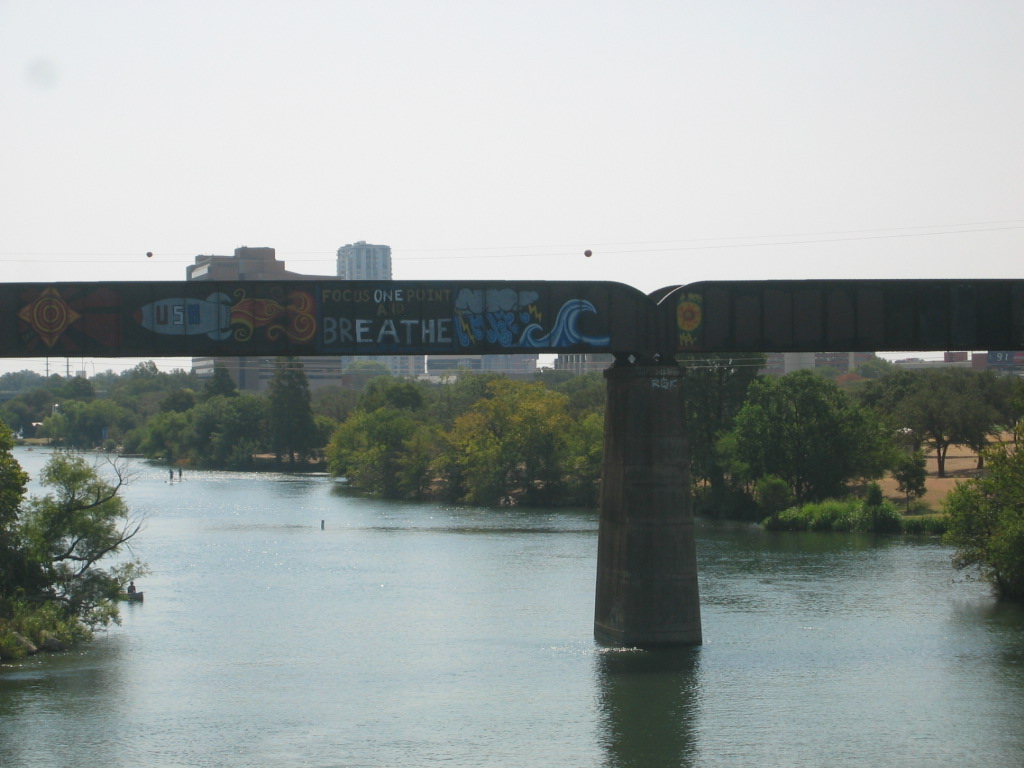
STOP! Unplug…..Focus One Point and Breathe

Yes.  I am going to invite you to go on a “media fast” this week.  That means smart phones, internet, television, newspapers, ……   Choose one day, or take the entire week.  It is up to you.

The reason for this is to open into possibilities that are obscured by the sheer volume of stimulus that captures our attention every single moment of every single day.

What would it be like to have space to notice what is going on in the world around you….not what you are being told is going on.

Take as an example my experience in doing this for the past 3 days in which I let go of my resistance to writing the first draft of a book on the breath that I have been sitting on for the past year.  I knew clearly that there were ideas and  creative paths that would not be open to me if I was returning e-mails, talking to people on the phone, and going out to make social connections.  Television and newspapers have not been part of my daily life for many years now, so that part was easy.

So I stopped.  I created a space for writing and just being with what unfolded itself before and within me.  So much more space appeared….and time slowed down.  The creative muse inside woke up and started an ongoing celebration resulting in an out pouring of ideas that resulted in 12,000 words written in 3 days.

During this three days I took a walk around the local lake here in Austin, Texas in the sultry 90 degree heat.  Not plugged into anything while I walked I was free to observe nature, people, dogs and the morning.

Half way through my walk I took a seat on a bench placed high above the lake on a pedestrian bridge.  My back was to another rail bridge that I had noticed before.  On it is painted in colors:  Focus One Point…and Breathe.  Graffiti art of the sacred kind.

With that reminder I did just that, and instead of being distracted by my minds constant barrage of chatter I was quieted as I gazed at the Lamar Street bridge directly in front of me, constructed with gracefully curved cement supports.  Sunlight helped to mirror these supports in the water creating an art piece of beautiful duplication.  What was above the water was also below.

It appeared to be another world in the water that was reverse from the one in air.  As I continued gazing a cloud obscured the reflection for a few moments and the magical world beneath the water was in shadow, disappearing before my eyes.  Once the light came out from behind the cloud this under water world was revealed once again.  It was there all along.

How many worlds, or possibilities are in the shadows, but still really there for us to shed light on and actively explore? Sitting with this I gazed down at the sidewalk just to my left and on it was written in colored chalk, “God bless you  friend” with a heart drawn at the end.

Walking back along the path I greeted an Austin resident who had brought his wheelbarrow down to the lake in order to transport water to the drought affected trees that grace this path.  Thanking him for what he was doing out of the kindness of his heart we exchanged a smile.  I am certain the trees felt the love directed at them.

Finally, climbing into my car and reaching to peel the juicy orange that awaited my return a man approached with a one gallon gas container.  He asked if I could spare some money to complete what he had in his pocket to purchase one gallon of gas.

Reaching into my wallet I took out my last dollar bill and grabbed some quarters and handed them to him commenting to please excuse the quarters as they had a bit of dark chocolate melted onto them.  We exchanged a smile and I was told once again “Thank you and God bless!”’’

Now, my question is would I have experienced all of this if I had earplugs in listening to music or whatever, allowed my mind to set an agenda of a certain time I needed to be back home to begin writing again, had my eyes down on the path focused on how many miles I needed to go today in order to get a good workout, or was even busy thinking about what my next chapter in this book was going to be?

My point is – unplug.  Unplug from the distractions that put your life on hold while you are caught up with everyone else’s opinion, judgements and agendas – or your own for that matter.  Not forever mind you.  Just for periods of time to be reminded of the extraordinary life you have before you in this moment.  Relax into the spaciousness,  beauty, and unseen worlds that appear from out of the shadows.  Focus one point….and breathe.

OTHER BLOGS BY GAYE ABBOTT:
www.WildlyFreeWoman.com
www.NaturalWealthJournal.com

Breathing In A Danish Psychomotor View

Breathing Spaces is blessed to have a global readership which brings new perspectives on the breath to my attention.  I was most fortunate to connect with a Danish “psychomotor therapist” by the name of Siff L. E. Skovenborg just a month ago.

Siff  shared with me that Denmark has a high level education training program completely centered on a humanistic approach to movement, breath, and body awareness.  Of course I was intrigued and asked if she would write an article for BreathingSpaces.

Below you will find her article.  I invite you to dialog with Siff either via a comment here, or directly to her e-mail below.

Breathing In A Danish Psychomotor View

By Siff L. E. Skovenborg – psychomotor therapist

Being a therapist and teacher of psychomotricity in Denmark, working with breath and breathing patterns has for years been a special interest for me. Psychomotricity is a therapy with roots in phenomenology and body therapy (Reich and Lowen) as well as anatomy and physiology. The tradition however goes further back than that. The Danish psychomotoric tradition started in the 1930’s and sprung from dance, performance and gymnastics into a manual treatment therapy. The focus has always been to balance the work of the muscles and to increase the awareness of the body so that the bodily impulses could spring more freely and expressively. In that way the view of the body has roots in the humanistic approach.

The body is viewed as a totality – there’s no real division between mind and matter – only when we focus the attention to one dimension it seems to be a difference in expression. The same goes for the breath. The way we breathe is the way we live. Holding or controlling breath is holding or controlling the life we lead. Breathing solely in the belly or the chest is avoiding contact or relation to the emotions or sensations in these areas.

Still there are two ways for the breath to function: autonomic or voluntary. Voluntary is when you control the breath either to increase the expanse or to decrease or even stop breathing for a shorter or longer period. Still we breathe when sleeping, when being unaware or in need for more air for instance when exercising. However the controlled breathing can become a pattern that affects the autonomic function. Doing breathing exercises or being afraid of being in touch with emotional responses can limit where the breath goes, how much air we breathe in or out and how the muscles that make the breathing happen works.

So the work of a psychomotoric therapist is to open for the breathing space and for more autonomic control, so that you get a free, diverse breathing that regulates itself according to the situation. In order to do so, we have different approaches depending on the client’s history and resources (bodily/mentally and socially).

If a client that has learned a controlled breath for example in yoga classes and believes that a belly breath is the only right way to breathe. Here the therapist can choose to educate the client about the physiology of breathing and the autonomic function. If the client has the possibility of viewing a small baby in his or her sleep the variety of breathing can be seen and understood. Then exercises to learn to let the breath control itself can be relevant. Jacques Dropsy author of ‘The Well-Tuned Body’ describes such exercises, that we also use in psychomotricity.

Another example could be a client who is afraid to be in touch with emotions, you need to teach the client to deal with emotions first. We do that by letting the client describe the bodily sensations in a matter of a fact way. What is a matter of fact is the heart beating, the sweat, the pulse, the muscle tension, the breath. If the client tends to talk from the emotions or the mind, the therapist keeps helping the client back to a descriptive approach. When this approach succeeds, the client experiences that the emotion or sensation lingers off. Gradually he experiences mastery of being in the present with the sensation without changing it willingly or forcefully. When this is learned we can start working directly or indirectly with breath.

As a psychomotoric therapist we tend to begin the work with the breath indirectly, as the direct approach can make the client too aware of the breath to let it work automatically. Indirect work is for example manually or through exercises which increase the elasticity of connective tissue around the body, or by doing exercises that demand more oxygen and therefore forces the body to take deeper or stronger breaths.  Direct work is breathing exercises, manual treatment on primary or secondary breathing muscles, or breathing awareness. When working directly with breath we almost always return to exercises that help the client to return to autonomic breathing.

Which approaches the therapist chooses, depends on the type of client. Every client is met on his or her own terms and the therapist always strives to engage the client to investigate the bodily/emotional/mental phenomenon together.

For more information you are welcome to contact me at sisk@ucc.dk or post@kropsliv.dk

OTHER BLOGS BY GAYE ABBOTT:

www.WildlyFreeWoman.com
www.NaturalWealthJournal.com

Essensual Breath

“There are moments of insight when ancient truths do stand out more vividly,  
and one senses anew his relationship to the earth and to all life.  
Such moments are worth waiting for, and when they come  
in some unheralded instant of knowing,  
they are of the purest gold.”

Sigurd Olson

The ocean was never more than 5 blocks away growing up and in my first years was just over a short wall to the beach with

Mission Beach, San Diego, California

waves beckoning to a young child to come and play.  Given this you will understand why today I was so strongly drawn to the ocean that nothing could keep me away.

A 50 minute drive had me in direct proximity with the smell of salt air, the sound of waves rolling, and gulls sounding off in the air.  Even though the sun was hidden there were many children, adults, and dogs celebrating the gifts of being near to the sea (and in it!).

When our senses are evoked by nature, feelings of love, a burst of creativity, tantalizing smells, pleasing sounds, luscious tastes, or the tender touch of a hand – our breath responds.

When I left my home my breath was shallow and constricted.  After arriving at the beach and walking along the shore with lower legs caressed by salt water my breath became full and expanded.

What is it that connects our senses with the breath?  Perhaps it is the “essensual” connection with that which we are created from – our home inside on the deepest cellular level.  When our senses are filled – our breath is full.

Spending countless hours sitting in front of computers/electronics, watching television for some, and hooked into sedentary lifestyles and mind games we have forgotten that we even have a full array of senses that can give us unending pleasure, ignite our life dreams, and connect us to the whole of all that is around and within us.

What would it be like if today you took a “senses break”.  In other words choose one of your senses –   nose/smell; eyes/visual; ears/hearing; skin/touch – kinesthetic; or tongue/taste.  I invite you to take a 15 minute “sense break” and completely focus in with that particular sense.

What is your experience?  Has your breath changed as you allow your one sense to be the connector moment to moment?  Now see if you can focus into the moment with all 5 senses and notice how the breath may change.

All life that came before us depended upon senses to navigate their particular place in the world.  Their survival actually depended upon it.  How might we bring back a deeper connection with our senses…and thus with our breath? As this connection deepens, and in some cases returns, our direct experience of life in the moment expands.

In return, our full embodied breath can also ignite our senses.  Just taking one full breath activates the nasal passages/smell as we bring more air into and out of our body; increases visual depth and acuity as oxygen stimulates our visual receptors; creates a soft sound that tells us “we are alive and breathing”; expands our chest, ribcage, back and belly, massages organs and the lymphatic/circulatory systems, and causes increased sensitivity to touch as the breath moves in and out; and stimulates appetite to “taste” more of life as we increase our aliveness with a full breath.

What is holding you back from using your senses more to feel, hear, taste, touch and see?  Don’t miss huge parts of your life!  As Jon Kabat-Zin, Ph.D says in the video below: “Pay attention in an open-hearted way to the full range of your capacities and resources.”  

Breathe it in!!

Sense Mindfulness with Thich Nhat Hanh (a favorite person and teacher!) – Stop running and pay attention to the now with all of  your senses…..

OTHER BLOGS BY GAYE ABBOTT:

www.WildlyFreeWoman.com
www.NaturalWealthJournal.com

Many Paths to Stillness of the Breath

“When the breath is irregular, the mind is also unsteady; but when the breath is still, so is the mind.” ~ Pradipika

I start with this quote as I am going to venture a bit away from it…well maybe way off from it.  But not really, because after practicing the primate Hu Breath I do believe that there will be so much opening in your body, that the return to stillness will be automatic -and deeper – and all irregularities will simply vanish!  There are many paths to reach a destination I say…

However, you may find yourself laughing with abandon before you finish this little practice.  Caryn McHose and Kevin Frank have written a delightful book called, How Life Moves, Explorations in Meaning and Body Awareness.  The book literally fell off my shelf today as I was sorting through books I want to keep in my move to Austin, and those that I will be gifting away.  Let’s just say that I will be keeping this one!

Directions follow which come straight from the book. This practice is the invention of Emilie Conrad, the founder of Continuum.

To do the Hu Breath, start by sitting comfortably on the floor, on a chair, or atop a physioball.  Breathe through your mouth.  On each exhale make a “ha” or “hee” or “hu” sound.  Breathe continuously in and out, moderately quickly, creating a visible pumping of the belly and letting the mouth experiment with different Simian expressions.  (that means monkey movements and sounds my friends!)  Allow the rhythm of the breath to pulse the body.  Play with the movement using an imagined sense of monkey and jungle persona to inspire the shapes of the movement.”

Personally I suggest that if you have a physioball, use it (bouncing is absolutely delicious!), as it creates another element to freeing your body and breath into movement freedom and instant laughter!  Breathing Spaces are only limited if you inhibit them….so I say go for it today and try on something completely different.  (even though I suspect that for some of you this will be just normal everyday behavior!)  Enjoy and let me know how you feel!!

OTHER BLOGS BY GAYE ABBOTT:

www.WildlyFreeWoman.com

www.NaturalWealthJournal.com

Make Room In Your Pelvis

Have you ever checked in with the tension that you may be holding in your pelvic floor muscles??  If you live in a Western culture I would be willing to bet that there is quite a bit of unnecessary tension there (we don’t squat much!), which is coupled with self image and the way we think and feel about ourselves and the world we inhabit.

The pelvis is part of the lower breathing space and pelvic floor muscles directly affect the quality and fullness of our breathing.  Here is what Dennis Lewis says about it in Breathe Into Being:

These muscles include the perineum, located between the anus and sexual organs, and the pelvic diaphragm, which stretches across the floor of the pelvic cavity.  In healthy natural breathing, during inhalation the diaphragm in the chest moves downward, the belly expands outward, the abdomen widens in all directions, and the pelvic floor moves slightly downward.  During exhalation, the entire process is reversed, with the pelvic diaphragm moving slightly upward.  If the pelvic floor is chronically constricted in any way, a spontaneous natural breath is not possible.  The free movement through us of the breath of life requires a pelvic floor that is both relaxed and resilient.”

When these muscles are relaxed and open you will also feel more grounded  and rooted to the earth and a sense of peacefulness may flow in.    Increasing awareness in this area is done by squatting more often, and paying attention to the muscles in the pelvic floor and whether they are guarded and tense, or relaxed and open.

Squatting can be difficult for some, so if this is true for you, then simply put something underneath your heels. You can also place your hands in front of you on the floor for balance.  As you squat, notice as you breath the movements in belly, back, pelvis and chest.  Also notice if there is a shift in your tension level, emotions, and mind chatter.  The belly may soften, relax, and let go.  As you practice this it will become easier over time. Muscles will open up that have been chronically tight and holding on for years.

When to do this?  Whenever you might choose to sit in a chair – instead squat!  Watching T.V., listening to music, talking on the phone….the possibilities are endless.  Try it out with the intention of just observing and watching your breath.  This practice is not meant to be a work out move or even a yoga technique!  It is simply inhabiting your body, grounding to the earth,  and making more room for life!

OTHER  BLOGS BY GAYE ABBOTT:

www.WildlyFreeWoman.com

www.DivineLifeJournal.com